I really enjoyed reading both of the short stories of ''Looking for Work'' and ''What We Really Miss About the 1950's.''
The Use of T.V. as a guide to what a modern household should look like was very interesting in ''Looking for Work.'' The author mentioned the t. v. shows of ''Leave it to Beaver'' and a program of a Polynesian tribe eating turtle stew as a role model for what people believed at the time. Television was still new in the 1950's and the cultural norm was to be as what was seen on T.V. The Father was the bread winner and the Mother stayed at home with the children. The Author however has a subtle undertone of racism in his writing that was still obvious to him back in the 1950's. His entire idea of wanting to live the perfect T.V. life spawned from feelings of not being socially acceptable.
However, this story does not really address the social issues the author was facing at the time. He mentions feelings of not being accepted as the ideal family, but the author still paints a pretty portrait of his life working for money, going swimming, and eating peaches all the time. Furthermore white children today would love to sit at home with their brothers and sisters to a home cooked meal. The author did not really grab my attention as someone dealing with hard times in the 1950's
In the next book, ''What We Really Miss About the 1950's'' the author used research points to address peoples love for the 1950's as being the best decade of our century. She uses contrasting data that is for and against the idea that the 1950's were the decade to live in. On one hand she mentions the fact that the average middle class worker could buy a median size home with only 15-18 percent of their income while at the same time she mentions figures such as racial data showing the 1950's were not the most popular decade among blacks because of racial tensions. Continuing, the author also states that 3 out of 4 men coming home from ww2 did not enjoy having to shove their way back into a society where women had a greater role.
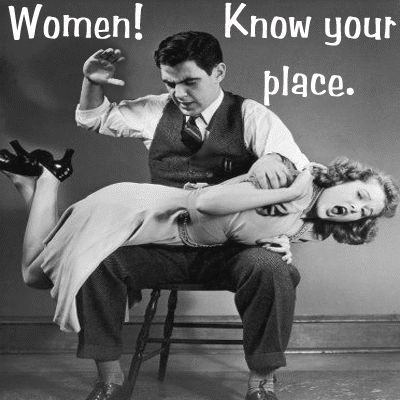
The use of data and the overall story in ''What We Really Miss About America'' does challenge cultural and social beliefs because it allows the reader to look at data and examine the ideas that even though life might have been portrayed as something to strive for, it was however difficult still for Women and Minorities.
In conclusion, both of these stories did give a pretty good idea of how life was is the 1950's and how we have only come so far since then. Both authors make a legitimate case for their findings and both used fascinating ways to express their ideas.
The Use of T.V. as a guide to what a modern household should look like was very interesting in ''Looking for Work.'' The author mentioned the t. v. shows of ''Leave it to Beaver'' and a program of a Polynesian tribe eating turtle stew as a role model for what people believed at the time. Television was still new in the 1950's and the cultural norm was to be as what was seen on T.V. The Father was the bread winner and the Mother stayed at home with the children. The Author however has a subtle undertone of racism in his writing that was still obvious to him back in the 1950's. His entire idea of wanting to live the perfect T.V. life spawned from feelings of not being socially acceptable.
However, this story does not really address the social issues the author was facing at the time. He mentions feelings of not being accepted as the ideal family, but the author still paints a pretty portrait of his life working for money, going swimming, and eating peaches all the time. Furthermore white children today would love to sit at home with their brothers and sisters to a home cooked meal. The author did not really grab my attention as someone dealing with hard times in the 1950's
In the next book, ''What We Really Miss About the 1950's'' the author used research points to address peoples love for the 1950's as being the best decade of our century. She uses contrasting data that is for and against the idea that the 1950's were the decade to live in. On one hand she mentions the fact that the average middle class worker could buy a median size home with only 15-18 percent of their income while at the same time she mentions figures such as racial data showing the 1950's were not the most popular decade among blacks because of racial tensions. Continuing, the author also states that 3 out of 4 men coming home from ww2 did not enjoy having to shove their way back into a society where women had a greater role.
The use of data and the overall story in ''What We Really Miss About America'' does challenge cultural and social beliefs because it allows the reader to look at data and examine the ideas that even though life might have been portrayed as something to strive for, it was however difficult still for Women and Minorities.
In conclusion, both of these stories did give a pretty good idea of how life was is the 1950's and how we have only come so far since then. Both authors make a legitimate case for their findings and both used fascinating ways to express their ideas.


No comments:
Post a Comment